






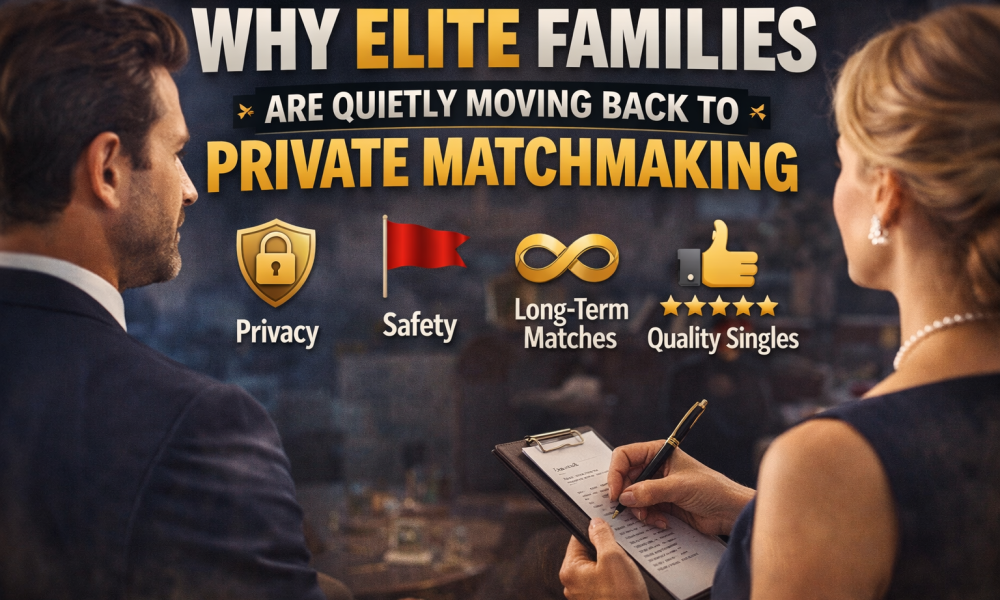

Why Elite Families Are Quietly Moving Back to Private Matchmaking
In Dhaka’s elite circles, trends rarely announce themselves loudly.
They move quietly.
They begin behind closed doors, in drawing rooms where tea is served in porcelain cups, where conversations are measured, and where decisions are never rushed. By the time the public notices a shift, it has already become established among those who value privacy most.
One such quiet shift is happening right now.
Elite families—business owners, professionals, diplomats, second-generation entrepreneurs, overseas Bangladeshis—are gradually stepping away from public matchmaking platforms and moving back toward private, discreet, curated marriage media services.
Not because technology failed.
Not because modernity reversed.
But because something deeper became clear:
When it comes to marriage, visibility is not always value.
And privacy is not outdated—it is powerful.
The Illusion of Infinite Choice
Over the last decade, digital matrimony platforms and dating apps promised something irresistible: unlimited options.
Hundreds of profiles. Thousands of filters. Global access. Immediate connection.
For many families in Dhaka’s elite community, this seemed efficient at first. Why rely on personal networks when algorithms could present matches within seconds?
But over time, something unexpected happened.
The abundance of options began to feel overwhelming rather than empowering.
Parents felt confused. Candidates felt fatigued. Conversations became repetitive. Profiles blurred into one another.
When everything looks available, nothing feels meaningful.
Elite families—who are used to precision in business and intentionality in life—started recognizing a problem:
Marriage cannot be optimized like a shopping experience.
It requires depth, not volume.
And volume is exactly what public platforms are built for.
Reputation Is Fragile in High Society
In Dhaka’s elite circles, reputation is not just social currency—it is legacy.
A family name carries decades of history. Business alliances, political relationships, social standing, educational pedigree—these are interconnected layers of identity.
Public platforms, however, do not operate with this nuance.
When a profile is uploaded openly, it enters a space where:
- Screenshots can circulate.
- Details can be misinterpreted.
- Conversations can be shared.
- Rejections can become public knowledge.
Even without scandal, the mere visibility of searching can create discomfort.
Elite families often prefer that marriage discussions remain confidential—not because they are secretive, but because they understand how easily narratives can shift in social ecosystems.
Private matchmaking restores control.
It ensures that introductions happen selectively. That information is shared only with vetted parties. That discretion is maintained at every stage.
In environments where perception matters deeply, controlled visibility becomes invaluable.
The Emotional Cost of Public Searching
There is another layer rarely discussed: emotional exposure.
On open platforms, candidates are often viewed repeatedly, shortlisted, rejected, re-approached, compared.
This process can quietly erode confidence.
For highly accomplished individuals—CEOs, doctors, foreign-educated professionals—repeated digital rejection feels impersonal yet strangely public. Even when unseen, it leaves psychological traces.
Elite families have begun to realize that the search process itself shapes the emotional state of their sons and daughters.
Private matchmaking offers a different rhythm.
Fewer introductions.
More intentional conversations.
Less noise.
More dignity.
Instead of being one profile among thousands, individuals become carefully represented, contextualized, and understood.
That shift changes everything.
Algorithms Cannot Read Emotional Maturity
Technology is powerful—but limited.
Algorithms can match age, education, income bracket, height, location.
They cannot evaluate:
- Emotional readiness
- Family dynamics
- Communication style
- Conflict resolution patterns
- Ego balance
- Value alignment
Elite families increasingly recognize that marriage success depends less on checklists and more on psychological compatibility.
A curated matchmaker—especially one experienced in high-society cultural nuances—can sense subtleties no digital filter detects.
For example:
Two families may appear “perfect on paper.”
But one may prioritize public image, while the other values privacy deeply.
Such misalignments rarely show in biodata.
They reveal themselves only through conversation, intuition, and experience.
Private matchmaking restores the human element.
The Fear of Overexposure
In the age of social media, exposure has become normalized.
But among elite circles, restraint still carries prestige.
Families are increasingly cautious about:
- Digital footprints
- Data leaks
- Online impersonation
- Unverified backgrounds
- Casual inquiries without seriousness
Public platforms create broader access—but broader access also means weaker control.
Private matchmaking operates differently.
Profiles are shared only with pre-qualified candidates. Background verification is prioritized. Introductions are filtered before they reach families.
It is not about exclusivity for its own sake.
It is about safeguarding vulnerability.
Marriage discussions are inherently personal. Elite families prefer environments where that vulnerability is handled with care.
Status Is No Longer Enough
There was a time when matching status—wealth, property, education—felt sufficient.
Today, elite families understand something more complex:
Two powerful families can still create an unhappy marriage.
Because compatibility is not transactional.
Modern elite sons and daughters often seek:
- Emotional safety
- Intellectual equality
- Shared lifestyle vision
- Respect for career ambitions
- Healthy boundaries
These qualities require deeper evaluation than a profile can offer.
Private matchmakers increasingly act as emotional interpreters—understanding expectations before introductions happen.
This reduces mismatched proposals and preserves energy.
The Quiet Return to Controlled Networks
Interestingly, this shift is not entirely new.
Before digital platforms, elite marriages often occurred through:
- Trusted referrals
- Close social networks
- Confidential intermediaries
The difference today is structure.
Modern private marriage media blends tradition with professionalism:
- Background checks
- Structured family meetings
- Psychological awareness
- Confidential documentation
- Process management
Elite families are not rejecting modernity.
They are refining it.
They want technology—but without exposure.
Efficiency—but without chaos.
Options—but without noise.
Private matchmaking provides that balance.
The Fatigue of Too Many Conversations
In open platforms, initial conversations are easy.
Ending them is harder.
Candidates often find themselves juggling multiple discussions simultaneously. Emotional energy becomes fragmented. Attention splits.
For high-performing professionals, this creates subtle burnout.
Marriage begins to feel like another task—another negotiation—another performance.
Private matchmaking slows the pace intentionally.
Instead of ten parallel introductions, families may focus on one or two carefully vetted matches at a time.
This protects emotional bandwidth.
It restores seriousness to the process.
Parents Want Structure. Children Want Autonomy.
In Dhaka’s elite society, marriage decisions often involve both generations.
Parents seek security and reputation alignment.
Children seek personal connection and compatibility.
Public platforms tend to tilt toward individual browsing.
Private matchmaking creates structured collaboration.
Matchmakers mediate expectations. They interpret concerns. They balance generational perspectives.
This reduces conflict before it escalates.
Families feel guided rather than overwhelmed.
The Redefinition of Luxury
Luxury has changed.
It is no longer about grand weddings or designer venues.
It is about:
- Peace of mind
- Privacy
- Time efficiency
- Emotional safety
- Curated experiences
In this sense, private matchmaking has become a modern luxury service.
Not flashy.
Not loud.
But deeply intentional.
Elite families are not announcing this shift publicly.
They are simply choosing differently.
Quietly.
When Discretion Becomes a Competitive Advantage
In elite circles, subtlety signals strength.
When families choose private matchmaking, they are making a statement without speaking:
“We value depth over display.”
This choice also influences outcomes.
Because when introductions happen confidentially:
- Expectations are clearer.
- Families are better prepared.
- Misunderstandings reduce.
- Gossip minimizes.
- Decision-making becomes calmer.
The process itself becomes part of the success.
A Cultural Evolution, Not Regression
Some might interpret this shift as conservative.
It is not.
It is evolutionary.
Elite families are not moving backward.
They are moving inward.
They are recognizing that:
Marriage is not content.
It is not a trend.
It is not a public performance.
It is a long-term partnership that shapes emotional and generational futures.
Such decisions deserve environments built for depth—not visibility.
The Rise of Intentional Matchmaking
The most significant shift may be this:
Elite families are no longer looking for more options.
They are looking for better filters.
They are seeking professionals who understand:
- Social nuance
- Emotional dynamics
- Cultural expectations
- Reputation management
- Confidential handling
Private matchmaking is no longer a backup option.
It is becoming the preferred one.
Quietly.
Strategically.
Intentionally.
The Future of Elite Marriage Decisions in Dhaka
As Dhaka continues to globalize, expectations will grow more complex.
Overseas education.
Dual-career households.
Cross-cultural exposure.
Financial independence.
With complexity comes the need for clarity.
Elite families increasingly realize that clarity does not emerge from scrolling.
It emerges from conversation.
From context.
From confidentiality.
Private matchmaking is not replacing choice.
It is refining it.
Not shrinking options.
But structuring them.
Not limiting freedom.
But protecting dignity.
Conclusion: The Quiet Confidence of Privacy
Trends shout.
Confidence whispers.
The move back to private matchmaking among Dhaka’s elite is not dramatic. It is deliberate.
It reflects maturity.
It acknowledges that marriage decisions require more than algorithms and public platforms can provide.
In an age where visibility is everywhere, privacy has become rare.
And what is rare becomes valuable.
Elite families understand this deeply.
They are not abandoning modernity.
They are redefining it—on their own terms.
Quietly.
Why Elite Families Are Quietly Moving Back to Private Matchmaking
(Extended Deep Analysis)
If the first wave of digital matchmaking was driven by curiosity, convenience, and modern optimism, the current shift toward private matchmaking is driven by something else entirely:
Experience.
Elite families in Dhaka are not reacting impulsively. They are responding to patterns they have observed over the last decade—patterns that reveal the limitations of public platforms in high-stakes marriage decisions.
What appears on the surface as a simple preference for privacy is, in reality, a complex recalibration of values.
The Hidden Exhaustion of Public Platforms
One of the least discussed realities in elite circles is emotional exhaustion.
When profiles are publicly visible, families often receive:
- Frequent but unserious inquiries
- Interest from socially mismatched families
- Repetitive biodata exchanges
- Conversations that fade without closure
At first, this feels like opportunity.
Over time, it feels like noise.
Elite families are used to filtering complexity in business, but when that complexity enters personal life, it feels intrusive.
Marriage discussions are emotionally charged. Every introduction carries hope. Every rejection carries disappointment—even if subtle.
Public platforms amplify this cycle.
Private matchmaking reduces it.
By limiting exposure and increasing screening, the emotional turbulence decreases significantly.
That alone is a compelling reason for the shift.
Elite Anxiety: The Fear of Misalignment
In Dhaka’s high society, misalignment carries consequences beyond personal dissatisfaction.
A mismatched marriage can affect:
- Family reputation
- Business alliances
- Social networks
- Intergenerational relationships
Elite families understand that marriage is not purely romantic. It is structural.
Public platforms often emphasize individual compatibility without fully addressing family systems.
Private matchmakers, however, operate within relational ecosystems.
They evaluate:
- Family communication styles
- Social positioning comfort levels
- Public vs private value systems
- Long-term lifestyle expectations
For elite families, this systems-level awareness is critical.
Marriage is not simply between two people.
It is between two environments.
The New Vulnerability of Wealth
Wealth creates comfort—but also vulnerability.
Affluent families face specific risks:
- Financial opportunism
- Social climbing disguised as compatibility
- Hidden liabilities
- Reputation exploitation
On open platforms, these risks multiply.
Verification processes are often surface-level. Intentions are difficult to assess digitally.
Private matchmaking introduces an additional layer of protection.
Professional intermediaries observe patterns. They identify inconsistencies. They notice behavioral cues families may miss.
For elite households accustomed to risk management in business, applying similar diligence to marriage decisions feels logical.
It is not distrust.
It is prudence.
Digital Transparency vs Cultural Modesty
Bangladesh’s elite society exists in an interesting cultural duality.
Globally exposed.
Locally rooted.
Public digital matchmaking often reflects Western dating culture—transparent, direct, sometimes casual.
But elite Bangladeshi families still operate within a framework of cultural modesty.
They prefer:
- Gradual introductions
- Respectful communication
- Family-led discussions
- Structured progression
Private matchmaking aligns more closely with these expectations.
It allows modernization without abandoning cultural dignity.
The Psychological Impact of Comparison Culture
Public platforms create inevitable comparison.
Candidates are filtered, sorted, ranked.
Height.
Income.
University.
Family background.
Even if unintentionally, the experience becomes competitive.
Elite individuals—already accustomed to high performance—begin evaluating themselves through metrics rather than meaning.
This creates subtle anxiety.
Am I impressive enough?
Is there someone better one click away?
Should I wait?
Private matchmaking disrupts this comparison loop.
By narrowing options intentionally, it encourages focus rather than evaluation fatigue.
In psychology, fewer meaningful options often increase satisfaction.
Elite families are learning this firsthand.
The Rise of Emotional Intelligence in Marriage Decisions
Perhaps the most significant shift is this:
Elite families are becoming more emotionally aware.
Previous generations prioritized stability, wealth, and social parity.
The current generation prioritizes:
- Emotional communication
- Mental health awareness
- Work-life balance
- Respect for individuality
Public platforms struggle to measure these variables.
Private matchmakers increasingly act as emotional facilitators.
They ask difficult questions before families do.
They identify red flags early.
They ensure both sides are emotionally prepared—not just socially compatible.
This emotional layer is becoming non-negotiable among Dhaka’s elite.
The Generational Reset
Interestingly, the shift back to private matchmaking is often driven by the younger generation—not just parents.
Many elite sons and daughters initially explored apps or open platforms.
Over time, they recognized:
- Conversations felt transactional
- Depth was rare
- Intentions were unclear
- Time was wasted
They began requesting structure.
Privacy.
Guidance.
Elite youth are not rejecting autonomy.
They are redefining it.
They want choice—but curated choice.
They want independence—but informed independence.
Private matchmaking offers that equilibrium.
The Cost of Public Failure
In tightly connected social circles, news travels quietly but quickly.
When public courtships end badly, narratives circulate.
Even without scandal, whispers shape perception.
Elite families increasingly prefer minimizing visible trial-and-error.
Private matchmaking contains risk within controlled channels.
If introductions do not proceed, they close discreetly.
No public trail.
No visible digital footprint.
No awkward social overlap.
The value of this containment cannot be overstated in elite networks.
Marriage as Long-Term Risk Management
Elite families often approach decisions strategically.
Education.
Investment.
Property.
Business expansion.
Marriage is now viewed through a similar lens.
Not as cold calculation—but as long-term stability planning.
Private matchmaking offers structured evaluation processes that mirror professional due diligence:
- Background checks
- Financial transparency discussions
- Family compatibility conversations
- Expectation alignment meetings
This structure reassures families who are accustomed to formal risk assessment elsewhere in life.
The Myth of Modern Superiority
There was a period when digital matchmaking felt progressive and private matchmakers seemed outdated.
That perception is dissolving.
Elite families now see that sophistication is not determined by medium—but by process.
A refined private matchmaking service today is far from traditional rigidity.
It integrates:
- Technology for secure data management
- Psychological insight
- Cultural fluency
- Discreet client handling
The result feels contemporary, not regressive.
Time Efficiency for High-Performing Individuals
Time is one of the most valuable assets in elite circles.
CEOs, surgeons, entrepreneurs, overseas executives—these individuals cannot afford endless exploratory conversations.
Private matchmaking respects time.
By pre-screening candidates thoroughly, it ensures introductions are serious.
Less small talk.
More meaningful evaluation.
Efficiency without emotional haste.
The Rebuilding of Trust in Human Judgment
After years of algorithmic dominance, trust in human judgment is quietly resurging.
Elite families recognize that algorithms optimize patterns—not intuition.
Human matchmakers understand tone.
Subtext.
Unspoken hesitation.
Family dynamics.
In marriage decisions, these subtleties matter profoundly.
Trusting experienced human intermediaries restores nuance.
Privacy as Emotional Safety
Ultimately, the shift toward private matchmaking is about emotional safety.
Elite families want environments where:
- Vulnerability is protected
- Conversations remain confidential
- Decisions unfold calmly
- Pressure is minimized
In a hyper-visible world, such spaces are rare.
And rarity defines luxury.
The Long-Term Cultural Impact
If this trend continues, it may reshape elite marriage culture in Dhaka entirely.
We may see:
- Smaller, more intentional engagement periods
- Less public display during searching stages
- More emphasis on compatibility screening
- Greater role of structured intermediaries
The shift is subtle—but foundational.
The Quiet Confidence of Structured Choice

Quietly
At its core, this movement reflects confidence.
Confidence that privacy is not weakness.
Confidence that intentionality outperforms volume.
Confidence that dignity matters.
Elite families are not retreating.
They are refining.
They are choosing controlled environments over open marketplaces.
They are prioritizing depth over display.
They are recognizing that in matters of lifelong partnership, fewer but better introductions outperform unlimited browsing.
And they are doing it quietly.
Because true status rarely announces itself.
It simply chooses wisely.

Other Articles


Really lovely work here. The writing has a makeup glam-like blend to it, where eyeshadow eye makeup builds dimension, foundation coverage base keeps everything grounded, and cosmetic makeup-related details gently lead the eyes look through the piece. The final impression is polished, warm, and as satisfying as the perfect lipstick lip shade. Beautiful makeup beauty connection.