






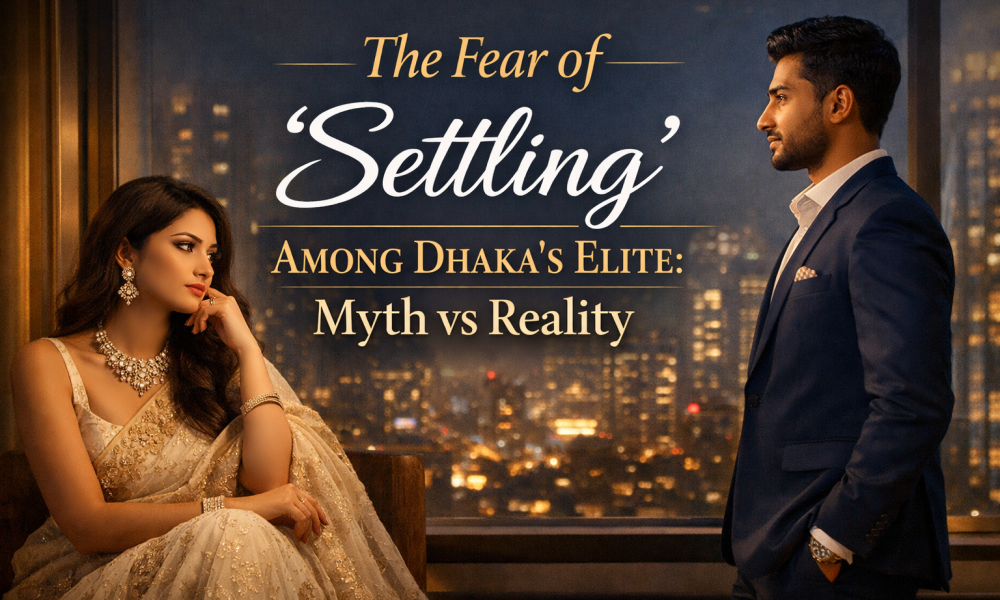

The Fear of ‘Settling’ Among Dhaka’s Elite: Myth vs Reality
This article is tailored for high-quality readership — professionals, families, urban elites, and anyone concerned with marriage, mindset, and life decisions in Dhaka’s social landscape.
Introduction: Understanding the Fear
In the bustling lanes of Dhaka — from Gulshan and Banani to Dhanmondi and Baridhara — marriage is more than a personal milestone. It is a cultural, social, and familial event. Yet, beneath the surface of engagement ceremonies and wedding announcements lies a subtle, powerful anxiety:
The fear of settling.
But what does it really mean to “settle”?
Is it a legitimate concern?
Or is it a myth amplified by social pressures, comparison, and misunderstanding?
In this deep exploration, we will examine:
- What the fear really is
- Where it comes from
- How it affects individuals and families
- And how those fears intersect with reality in Dhaka’s elite communities
Chapter 1: Defining “Settling” — More Than a Word
At first glance, the term “settling” sounds simple. It implies marrying someone less than ideal. But this definition is superficial.
To many people, especially in elite contexts, “settling” often means:
- Choosing safety over passion
- Prioritizing practicality over chemistry
- Making a decision based on convenience, not connection
- Accepting a partner who doesn’t excite you
But here’s the important nuance:
The fear of settling is rarely about the partner.
It’s about the fear of regret.
It is not:
“I don’t like this person.”
It is:
“What if I give up the best possible outcome?”
This fear is emotional, not rational — and that’s where myth and reality begin to diverge.
Chapter 2: The Social Mirror — Dhaka’s Elite and Expectations
In Dhaka, especially in affluent communities, marriage isn’t only about two individuals. It involves:
- Family reputation
- Cultural ideals
- Social expectations
- Peer comparison
When a young professional from Gulshan walks into a room, she might hear:
“Is he good enough?”
“Are they matching well?”
“Does he have a good job? A respectable family?”
Success in career and education becomes a lens for evaluating personal relationships. And where success thrives, expectations grow.
That pressure creates a landscape where:
- High standards become perfectionism
- Desire for the “right” match becomes fear of the “wrong” one
- The question becomes not “Is this person good?” but “Is this the best?”
This mindset fuels the fear of settling — not because relationships are inherently poor, but because the benchmark for choosing is set unrealistically high.
Chapter 3: Myth vs Reality — What “Settling” Actually Means
Here’s the central truth:
Settling is not about compromise — it’s about compromise without clarity.
Myth:
“Settling means marrying someone who is not good enough.”
Reality:
“Settling means making a decision without understanding your own values.”
This is crucial.
Let’s break it down:
Myth 1: Settling Means Choosing Someone Less Attractive or Successful
Many assume that settling means lowering standards.
Reality:
Attraction, success, or wealth do not guarantee connection. People can be high-achieving but emotionally disaligned.
Myth 2: Settling Happens Quickly and Without Thought
People fear quick decisions because they think speed equals error.
Reality:
Decisions made with clarity, values, and self-awareness are different from rushed choices. Settling is not speed—it’s lack of alignment.
Myth 3: Settling Leads to Unhappiness
This is perhaps the most ingrained belief.
Reality:
What causes unhappiness is not the partner — but mismatch of expectations with reality.
Chapter 4: The True Source of the Fear
So if “settling” isn’t what people think it is, then what is this fear?
Here are the real emotional drivers:
- Fear of Missing Out
Dubbed “FOMO,” this is the belief that a better partner always exists — if only one waits long enough.
- Fear of Finality
Marriage is symbolic. It says “I choose this, and not another.” The weight of that finality terrifies many.
- Fear of Regret
Regret is an emotional weight that feels heavier than failure.
- Fear of Judgment
Not just personal regret — the fear of being judged by society, family, or peers if the choice doesn’t “look ideal.”
These fears are deeply psychological — not relational.
And importantly, they don’t reflect the potential quality of the relationship. They reflect internal insecurity.
Chapter 5: When High Standards Become Unrealistic Expectations
Having standards is healthy.
Expectations — sometimes not so much.
Let’s distinguish:
Standards are grounded in values.
Expectations are grounded in external validation.
Example:
- Standard: “I want someone who respects family values.”
- Expectation: “I want someone my friends will admire.”
Standards reflect self-understanding.
Expectations reflect social mirrors.
The problem begins when social mirrors drive decisions — because society rarely sees the invisible dynamics of intimacy.
Chapter 6: Emotional Maturity vs Emotional Immaturity
Another core reason the fear of settling persists is lack of emotional vocabulary.
Many articulate:
“I want the perfect partner.”
But what they really mean is:
“I want to feel secure, valued, and understood.”
The fear of settling is often a fear of emotional insufficiency — not relational insufficiency.
People mistakenly evaluate compatibility through:
- Status
- Looks
- Resume
And overlook:
- Communication styles
- Emotional intelligence
- Family vision
- Conflict resolution
This disconnect breeds anxiety, not clarity.
Chapter 7: The Hidden Cost of Prolonged Waiting
Waiting for the “perfect” match feels safe — until it becomes stagnation.
People who wait too long may encounter:
- Increasing social pressure
- Heightened performance anxiety
- Deeper fear of judgment
This waiting is not freedom. It is fear disguised as choice.
The irony is that the search for perfection often leads to perpetual hesitation.
And hesitation is not strategy — it is avoidance.
Chapter 8: When “Good Enough” Becomes Beautiful
This is where myth meets reality.
A partner who is:
- Kind
- Emotionally available
- Compatible in core values
- Respectful and communicative
…these qualities often matter far more than:
- Financial status
- External validation
- Mirrored achievements
A relationship built on connection and understanding nourishes growth — and rarely feels like settling.
It feels like partnership.
Chapter 9: Societal vs Personal Standards
In Dhaka, societal standards often dominate personal ones:
- Education level
- Professional designation
- Family reputation
- Social circles
These are externally visible markers.
But they often mask the internal markers of compatibility:
- Emotional harmony
- Shared goals
- Growth mindset
- Conflict navigation
- Mutual respect
When personal standards are overshadowed by societal ones, the fear of settling becomes amplified.
Chapter 10: Why Comparison Is the Enemy of Clarity
Social comparison drives fear.
When people compare:
- Their partner to someone else’s
- Their progress to a peer’s
- Their timeline to a friend’s
…they stop evaluating what matters to them.
This breaks relationships before they begin.
True clarity arises not from comparison but from understanding:
“What do I value most in a partnership?”
Chapter 11: Family Expectations vs Individual Understanding
In elite contexts, family expectations can be both supportive and intimidating.
Often, families emphasize:
- “Good matches”
- “Respected backgrounds”
- “Established careers”
But families may overlook:
- Emotional readiness
- Personal goals
- Communication chemistry
This tension can pressure individuals into:
- Waiting longer
- Seeking better “options”
- Fearfully postponing commitment
Understanding the difference between family wishes and individual alignment is critical.
Chapter 12: When Fear Blocks Growth
The fear of settling often prevents people from stepping into what they truly want:
- Real connection
- Mutual understanding
- Honest partnership
- Emotional safety
Fear blocks clarity. It turns possibility into paralysis.
And paradoxically, fear makes people more risk-averse in areas where risk is actually emotional growth — not relationship failure.
Chapter 13: The Role of Discretion, Not Display
Public display of profiles, match statistics, and social validation inflates expectations.
Discreet, thoughtful matchmaking prioritizes:
- Genuine conversations
- Private evaluation
- Emotional compatibility
- Intent over popularity
In such environments, the fear of settling decreases — because decisions are not influenced by noise.
People evaluate compatibility, not comparison.
Chapter 14: Redefining “The Best”
Here’s a pivotal shift:
Instead of asking:
“Is this the best person?”
Ask:
“Is this the right person for me?”
This changes everything.
“Best” in general is a myth.
“Best for you” is a reality.
And discovering that requires introspection — not social comparison.
Chapter 15: The Courage to Choose — Without Regret
Making a decision with clarity and self-understanding takes courage.
It requires:
- Honesty about personal values
- Emotional awareness
- A willingness to examine fears
- Self-acceptance without social mirrors
When people choose from conviction — not comparison — they stop fearing “settling.”
Instead, they choose alignment.
Chapter 16: Real Stories — When Fear Gave Way to Fulfillment
Consider stories of individuals who:
- Waited not for perfection — but for alignment
- Found connection where societal markers were secondary
- Built families based on mutual respect, not social applause
These people didn’t settle.
They decided with depth.
Their lives are not examples of compromise.
They are examples of clarity.
Chapter 17: Practical Steps to Overcome the Fear
Here are actionable ways to transform fear into confidence:
Self-Reflection
Ask:
- What are my non-negotiables?
- What fears hold me back?
- What do I truly want?
Consultation, Not Comparison
Seek guidance from trusted mentors — not social peers.
Emotional Alignment First
Prioritize:
- Communication style
- Conflict approach
- Family goals
- Life vision
Private Evaluation
Avoid public noise influence.
Evaluate compatibility privately.
Growth Mindset
See marriage as co-creation, not conclusion.
Chapter 18: When Commitment Becomes Empowerment
Commitment isn’t a cage.
It is clarity.
When two people understand each other deeply, commitment becomes not a burden — but a decision of courage.
And courage is the opposite of settling.
Conclusion: Myth vs Reality Reframed
The fear of settling is not about the partner.
It is about:
- Fear of regret
- Social judgment
- Comparison
- Lack of clarity
- External expectations
But reality shows:
Settling is not a relationship problem.
Fear is a decision problem.
Clarity is the solution.
When people understand themselves clearly — what they want, what they value, what they deserve — the myth of settling dissolves.
Marriage then becomes not a compromise — but a choice of intention and alignment.
And that is not fear.
That is empowerment.
The Fear of ‘Settling’ Among Dhaka’s Elite: Myth vs Reality (Extended Continuation)
When Choice Becomes a Burden, Not a Blessing
One of the paradoxes of elite society in Dhaka is abundance.
There are more opportunities, more exposure, more introductions, more information than ever before. On paper, this should make marriage easier. Yet emotionally, it has done the opposite.
Too many choices don’t liberate the mind — they burden it.
When people feel that “better” is always just one conversation away, every existing option feels temporary. Nothing feels final. Nothing feels safe to choose.
This is not freedom.
This is anxiety disguised as possibility.
The fear of settling thrives in environments where choice never ends.
Why the Elite Fear ‘Ordinary’ More Than Unhappy
In many elite circles, there is a silent hierarchy of fears.
At the top is not divorce.
Not loneliness.
Not emotional distance.
It is ordinariness.
Being seen as someone who “could have done better” feels more threatening than being privately dissatisfied. This is a harsh truth, but a real one.
Many people would rather delay marriage indefinitely than choose a partner who does not impress society — even if that partner offers emotional safety, loyalty, and peace.
This fear is not about love.
It is about image.
How Elite Upbringing Shapes Decision Paralysis
From an early age, many individuals in Dhaka’s upper-middle and elite families are trained to excel.
Top schools.
Strong results.
Clear milestones.
Success becomes measurable.
Marriage, however, is not.
You cannot “optimize” a human being the way you optimize a CV. And for people conditioned to achieve the best outcome in every domain, this lack of certainty is terrifying.
They ask:
- “What if I choose wrong?”
- “What if I regret this?”
- “What if there was someone better?”
This mindset works in careers.
It fails in intimacy.
The Silent Competition Between Peers
In elite social groups, marriage is rarely a private milestone. It is quietly competitive.
Who married first.
Who married best.
Who married “up.”
These comparisons are rarely spoken out loud, but they shape inner narratives.
Someone else’s engagement can trigger doubt.
Someone else’s wedding can spark insecurity.
Someone else’s partner can redefine your own standards overnight.
In such an environment, the fear of settling becomes contagious.
Why Emotional Safety Is Undervalued
One of the biggest misconceptions among high-achieving individuals is undervaluing emotional safety.
Traits like:
- Calmness
- Consistency
- Reliability
- Emotional presence
…don’t photograph well.
They don’t impress at dinner parties.
They don’t stand out on paper.
So they are often dismissed as “boring.”
But emotional safety is not boring.
It is rare.
Many elite marriages struggle not because partners lacked ambition — but because they lacked emotional containment.
The fear of settling blinds people to this truth.
The Romanticization of ‘More’
There is a subtle belief among many elites that love must feel dramatic to be real.
Intense attraction.
High chemistry.
Strong highs and lows.
But intensity is not depth.
Drama is not compatibility.
In fact, many relationships that feel “exciting” initially become unstable long-term.
The fear of settling often pushes people away from calm connections toward volatile ones — simply because calm feels unfamiliar.
Why Self-Knowledge Is Scarce in Privileged Lives
Another uncomfortable reality: privilege often delays self-knowledge.
When life provides comfort, structure, and validation, people don’t always have to examine themselves deeply.
So when it comes time to choose a life partner, many ask:
“What do I deserve?”
instead of
“What do I actually need?”
Without self-knowledge, every decision feels risky — because there is no internal compass.
This fuels the fear of settling more than any external factor.
The Confusion Between Growth and Upgrade
Elite culture often treats relationships like upgrades.
Better lifestyle.
Better network.
Better presentation.
But marriage is not an upgrade.
It is a partnership for growth.
Growth requires:
- Patience
- Conflict
- Vulnerability
- Emotional labor
Those who fear settling often fear growth — because growth demands discomfort.
Why ‘Keeping Options Open’ Is Emotionally Costly
Keeping options open sounds empowering.
In reality, it erodes emotional depth.
People who constantly evaluate alternatives:
- Never fully invest
- Never fully trust
- Never fully commit
Over time, this creates emotional numbness.
Then when a genuinely good match appears, it doesn’t “feel” right — because the person has forgotten how depth feels.
They mistake numbness for clarity.
And walk away.
The Gendered Experience of Settling
For Women
Elite women often fear:
- Losing independence
- Being undervalued after marriage
- Sacrificing growth
So they delay — waiting for a partner who checks every box.
But no human being can represent total freedom, ambition, romance, and security all at once.
The fear of settling becomes a shield against vulnerability.
For Men
Elite men often fear:
- Being chosen for status, not self
- Being emotionally inadequate
- Being trapped in expectations
They may delay marriage not because they lack interest — but because they fear responsibility paired with insufficient emotional tools.
Both genders suffer — differently, but deeply.
Why ‘Later’ Feels Safer Than ‘Now’
Postponement feels safe because it postpones accountability.
As long as a decision is not made, regret cannot be confirmed.
But life does not pause.
Emotional readiness does not automatically increase with time.
Often, fear simply grows more sophisticated.
Later becomes never — quietly.
The Role of Families in Reinforcing Fear
Families, even loving ones, often unintentionally reinforce fear.
Comments like:
- “Don’t rush”
- “You deserve the best”
- “See more options”
…sound supportive, but often validate indecision.
Without guidance on how to choose — people remain stuck in evaluation mode.
Why the Fear of Settling Is Actually Fear of Self-Blame
At its core, the fear of settling is fear of personal responsibility.
If something goes wrong, people fear hearing:
“You chose this.”
So they delay choice altogether.
But avoiding responsibility does not prevent regret.
It only delays ownership.
Why Meaning Emerges After Commitment, Not Before
A powerful truth rarely discussed:
Meaning in relationships deepens after commitment.
Before commitment, everything is hypothetical.
After commitment, effort creates meaning.
People waiting to feel certain before choosing misunderstand how certainty works.
Certainty is built — not discovered.
The Illusion of Control in Elite Matchmaking
Many elites believe that careful filtering will prevent pain.
But relationships are not risk-free systems.
Pain is not a sign of failure.
It is a sign of emotional investment.
Trying to eliminate risk eliminates intimacy.
When Fear Masquerades as Wisdom
Fear often disguises itself as “being careful,” “being selective,” or “knowing one’s worth.”
True wisdom, however, is not avoidance.
It is discernment paired with courage.
Why Discreet Matchmaking Reduces the Fear
Discreet, human-led matchmaking removes:
- Comparison
- Public judgment
- Performance pressure
It restores focus to:
- Emotional alignment
- Values
- Long-term compatibility
When noise disappears, fear softens.
Reframing Settling as Choosing Alignment
Settling is choosing against your values.
Choosing alignment — even if imperfect — is not settling.
It is maturity.
The Quiet Regret of Those Who Never Choose
There is a regret rarely spoken about in elite circles.
Not the regret of marrying wrong —
but the regret of never fully choosing anyone.
This regret is quieter.
But it lasts longer.

Final Integration: Myth vs Reality, Rewritten
Myth: Settling ruins lives.
Reality: Fear ruins clarity.
Myth: Waiting ensures better outcomes.
Reality: Waiting often ensures deeper fear.
Myth: The best partner removes doubt.
Reality: The right partner grows with doubt.
Closing Reflection: Courage Is the Missing Ingredient
The fear of settling is not solved by more options, more profiles, or more time.
It is solved by courage.
Courage to know yourself.
Courage to accept imperfection.
Courage to choose alignment over admiration.
Courage to grow with someone — not evaluate endlessly.
Marriage is not about choosing the perfect person.
It is about choosing with clarity, and then building meaning together.
That is not settling.
That is wisdom.

Other Articles

Why Choosing the Right Marriage Media Matters in Modern Bangladesh

I enjoyed the angle here. It’s always nice to read something that feels well considered, and I’m appreciative you chose to share your thoughts.
There is a nice broad appeal to this. It feels appropriate for readers interested in tourism, eager for a vacation, open to adventure, preparing for a flight, or simply deciding which mini accessories deserve a permanent place in their bag.