





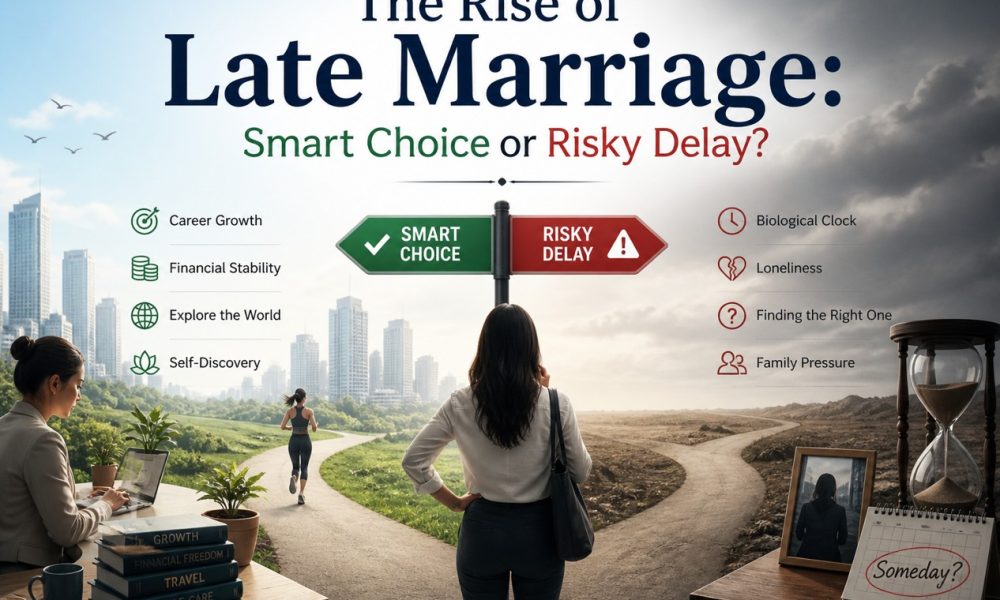

The Rise of Late Marriage: Smart Choice or Risky Delay?
Introduction: A New Era of Marriage Decisions
Marriage, once considered an early milestone in life, is no longer bound by strict timelines. Across the world—and increasingly in countries like Bangladesh—people are choosing to marry later than previous generations. What used to be considered “late” (late 20s or early 30s) is now becoming the norm rather than the exception.
This shift raises an important question:
Is late marriage a smart, well-thought-out decision—or a risky delay with long-term consequences?
The answer isn’t simple. Late marriage is not inherently good or bad—it is a complex social phenomenon shaped by education, career goals, financial realities, emotional readiness, and evolving cultural values.
In this blog, we will explore the causes, benefits, risks, and real-life implications of late marriage to help you understand whether it is truly a wise choice or a hidden gamble.
Chapter 1: What Is Considered Late Marriage?
Late marriage typically refers to marrying in your 30s or later, though the definition varies depending on cultural and societal context. (The Queen Zone)
In traditional societies:
- Women often married in their early 20s
- Men married by their mid-to-late 20s
Today:
- Many individuals are unmarried even in their mid-30s
- Some are choosing marriage in their 40s—or not at all
This shift signals a deeper transformation—not just in age, but in mindset.
Chapter 2: Why Are People Marrying Later?
- Education Comes First
One of the biggest reasons behind late marriage is education. People now:
- Pursue higher studies (Master’s, PhD)
- Focus on skill development
- Delay commitments to build knowledge
Research shows that many individuals postpone marriage until completing their education. (Socio.Health)
- Career and Financial Stability
Modern life demands financial security before settling down:
- Job stability
- Savings
- Career growth
Many individuals believe:
“First build your life, then build a family.”
This mindset naturally pushes marriage into the 30s.
- Changing Social Norms
Society is evolving:
- Less pressure to marry early
- Acceptance of single life
- Rise of independent living
Younger generations prioritize personal freedom and self-growth before commitment. (Socio.Health)
- Fear of Divorce and Wrong Choices
People today are more cautious:
- They want compatibility, not compromise
- They observe failed marriages around them
- They take time to choose the right partner
- Personal Growth and Emotional Readiness
Many individuals now ask:
- “Am I mentally ready?”
- “Do I truly understand relationships?”
This self-awareness delays marriage—but often improves decision quality.
Chapter 3: The Advantages of Late Marriage
Let’s explore why many consider late marriage a smart choice.
- Emotional Maturity
With age comes:
- Better communication skills
- Emotional intelligence
- Conflict resolution ability
Older individuals are less impulsive and more understanding.
- Financial Stability
Late marriage often means:
- Stable income
- Less financial stress
- Better lifestyle planning
Financial independence allows couples to marry by choice, not necessity. (Lagnavaarta Matrimony)
- Better Partner Selection
When you marry later:
- You understand your preferences
- You recognize red flags
- You choose compatibility over pressure
Studies suggest people marrying later are more likely to make informed partner choices. (canadianreview.net)
- Lower Divorce Risk (In Some Cases)
Maturity leads to:
- Realistic expectations
- Better conflict handling
- Less impulsive decisions
Some research suggests that delayed marriage can reduce divorce risk due to improved compatibility.
- Personal Fulfillment Before Marriage
Late marriage allows individuals to:
- Travel
- Build careers
- Explore passions
This leads to:
- Less regret
- More satisfaction in married life
Chapter 4: The Risks and Challenges of Late Marriage
Now let’s look at the other side of the story.
- Fertility Issues
One of the biggest concerns is biological:
- Female fertility declines after the late 20s
- Pregnancy risks increase with age
- Male fertility also decreases over time
Medical experts warn that delayed marriage often leads to difficulty in conceiving and increased reliance on treatments like IVF. (Drug Today)
- Health Complications
Late pregnancy may involve:
- High blood pressure
- Diabetes
- Pregnancy complications
These risks can impact both mother and child.
- Reduced Time for Family Planning
Late marriage means:
- Less time for having multiple children
- Pressure to start a family quickly
- Emotional Loneliness and Social Pressure
In many cultures (including Bangladesh):
- Unmarried individuals face questions and criticism
- Social pressure can cause stress and anxiety
A study found that many late unmarried individuals experience depression and lack of focus. (ACS Publisher)
- Difficulty Adjusting to Married Life
When people live independently for years:
- Habits become fixed
- Adjusting to a partner becomes harder
This can lead to:
- Conflicts
- Lack of compromise
- Compatibility Becomes Complex
With age:
- Expectations increase
- Standards become rigid
Finding the “perfect match” becomes more difficult.
Chapter 5: Late Marriage in Bangladesh Context
In Bangladesh, late marriage is still a sensitive topic.
Traditionally:
- Early marriage was common
- Family pressure was strong
Now:
- Urban youth are delaying marriage
- Education and career priorities are rising
However, research shows:
- Late marriage is increasing among educated youth
- Many delay marriage due to lack of readiness or financial stability (ACS Publisher)
At the same time:
- Social stigma still exists
- Family expectations remain strong
This creates a conflict between modern values and traditional culture.
Chapter 6: Psychological Impact of Late Marriage
Positive Effects
- Increased self-confidence
- Emotional independence
- Better self-awareness
Negative Effects
- Loneliness
- Fear of missing out (FOMO)
- Anxiety about finding a partner
From online discussions:
“Late or no marriage is still better than a wrong marriage.” (Reddit)
This reflects a growing mindset:
👉 People prefer being single over making the wrong decision.
Chapter 7: Late Marriage vs Early Marriage
| Factor | Early Marriage | Late Marriage |
| Emotional Maturity | Lower | Higher |
| Financial Stability | Less | More |
| Fertility | High | Lower |
| Divorce Risk | Higher (sometimes) | Lower (sometimes) |
| Personal Freedom | Limited | High |
There is no universal “best age”—only the right timing for the individual.
Chapter 8: Is Late Marriage Really a Smart Choice?
It is a smart choice if:
- You are building your career
- You are emotionally not ready
- You want financial stability
- You are careful about partner selection
It becomes risky if:
- You delay without purpose
- You ignore biological realities
- You become overly selective
- You avoid commitment out of fear
Chapter 9: The Hidden Danger—Endless Delay
One major issue is not late marriage itself—but indefinite postponement.
People often say:
- “I’ll marry after I settle”
- “I’ll marry when everything is perfect”
But perfection never comes.
This leads to:
- Missed opportunities
- Reduced options
- Emotional isolation
Chapter 10: How to Decide the Right Time to Marry
Ask yourself:
- Are you emotionally ready?
- Can you compromise?
- Can you handle responsibility?
- Are you financially stable (not perfect, but stable)?
- Do you understand relationships?
- Are you delaying for growth—or fear?
Chapter 11: Expert Insight
Experts agree:
- Late marriage is neither good nor bad
- It depends on individual circumstances
It offers:
✔ Stability
✔ Maturity
✔ Better decisions
But also:
⚠ Biological risks
⚠ Emotional challenges
⚠ Social pressure
Conclusion: Smart Choice or Risky Delay?
So, what is late marriage?
👉 It is a smart choice when done consciously
👉 It becomes a risky delay when done carelessly
The real question is not:
“When should you marry?”
The real question is:
“Are you ready to marry?”
Because:
- Early marriage without maturity leads to regret
- Late marriage without awareness leads to struggle
The best marriage is not early or late—
It is the right marriage at the right time for YOU.
The Rise of Late Marriage: Smart Choice or Risky Delay? (Extended Deep Analysis)

Chapter 12: The Economics Behind Late Marriage
One of the most overlooked but powerful drivers of late marriage is economics. In today’s world, marriage is no longer just a social or emotional decision—it is also a financial one.
- Rising Cost of Living
Urban life, especially in cities like Dhaka, has become significantly more expensive:
- Housing costs are high
- Education expenses are increasing
- Healthcare costs are rising
- Lifestyle expectations have changed
Young individuals often feel:
“I can’t afford marriage yet.”
This mindset leads to delayed decisions, as people want to ensure:
- Stable income
- Savings
- Financial independence
- The Pressure of “Lifestyle Matching”
Unlike previous generations, today’s couples look for:
- Similar income levels
- Similar social status
- Matching lifestyle expectations
This creates a delay because:
- Finding such compatibility takes time
- Financial gaps create hesitation
- Dual-Income Expectations
Modern marriages often rely on dual-income households. Many individuals prefer:
- A financially independent partner
- Someone with career ambition
This further delays marriage because both individuals prioritize:
👉 Career establishment before commitment
Chapter 13: The Role of Technology and Social Media
Technology has completely transformed how people approach relationships and marriage.
- Endless Options Create Endless Confusion
Dating apps and social media provide:
- Unlimited choices
- Exposure to different personalities
- Access to global matchmaking
But this also creates:
- Decision paralysis
- Unrealistic expectations
- Fear of settling
People keep thinking:
“Maybe someone better is out there.”
This mindset leads to constant delay.
- The “Perfect Life” Illusion
Social media platforms show:
- Perfect couples
- Luxury lifestyles
- Romanticized relationships
This creates unrealistic standards:
- People expect perfection
- Real-life relationships feel “less exciting”
As a result:
👉 Individuals delay marriage waiting for an ideal that doesn’t exist
- Digital Independence
Technology allows people to:
- Live independently
- Work remotely
- Stay socially connected without marriage
This reduces the urgency to marry.
Chapter 14: Gender Dynamics in Late Marriage
Late marriage affects men and women differently.
- Women and Late Marriage
Advantages
- Career growth
- Financial independence
- Better partner selection
Challenges
- Biological clock pressure
- Social stigma
- Family pressure
In many societies:
- Women face stronger expectations to marry early
- Late marriage may lead to increased scrutiny
- Men and Late Marriage
Advantages
- Financial stability
- Career establishment
- Social acceptance
Challenges
- Emotional isolation
- Commitment issues
- Difficulty adapting to family life
Men often delay marriage thinking:
“I have more time.”
But emotional readiness does not always grow automatically with age.
Chapter 15: The Psychological Shift in Modern Relationships
Late marriage is not just about age—it reflects a psychological transformation.
- From Duty to Choice
Earlier:
- Marriage was a social duty
Now:
- Marriage is a personal choice
This shift has:
✔ Increased freedom
❌ Increased confusion
- Fear of Commitment
Many people today experience:
- Fear of losing freedom
- Fear of wrong decisions
- Fear of emotional vulnerability
This leads to:
👉 Procrastination in marriage decisions
- Overthinking and Analysis Paralysis
Modern individuals:
- Analyze everything deeply
- Compare multiple options
- Fear making mistakes
Result:
👉 No decision at all
Chapter 16: The Biological Reality People Ignore
While society evolves, biology does not change as quickly.
- Fertility Window
For women:
- Peak fertility: early to mid-20s
- Decline starts: late 20s
- Significant decline: after 35
For men:
- Fertility declines gradually
- Sperm quality reduces with age
- Emotional vs Biological Timing
Modern life creates a mismatch:
- Emotional readiness comes late
- Biological readiness comes early
This creates a dilemma:
👉 When you are ready mentally, your body may not be at its peak
- Medical Dependency
Late marriages often lead to:
- IVF treatments
- Fertility medications
- Increased medical costs
This adds:
- Financial stress
- Emotional pressure
Chapter 17: Social Pressure vs Personal Freedom
Late marriage exists at the intersection of:
👉 Society
👉 Individual choice
- The Pressure Never Disappears
Even in modern societies:
- Relatives ask questions
- Parents worry
- Social comparisons happen
Common questions:
- “When are you getting married?”
- “What are you waiting for?”
- The Rise of Individualism
At the same time:
- People value independence
- Personal goals matter more
This creates internal conflict:
👉 “Should I follow society or my own path?”
Chapter 18: Late Marriage and Divorce Trends
An important question:
👉 Does late marriage reduce divorce?
- The Reality
Late marriages:
- Often have better communication
- Are based on conscious decisions
But:
- Higher expectations can cause conflict
- Less flexibility can create issues
- The Balance
Late marriage reduces:
✔ Impulsive decisions
But increases:
⚠ Expectations
⚠ Ego conflicts
Chapter 19: The “Too Late” Trap
One major risk is crossing from “late” to “too late.”
- What Happens When You Wait Too Long?
- Limited partner options
- Increased expectations
- Emotional fatigue
- The Illusion of Time
People often think:
“I still have time.”
But time moves faster than expected.
Chapter 20: Real-Life Scenarios
Case 1: The Career-Focused Individual
- Delays marriage until 35
- Achieves financial success
- Struggles to find a compatible partner
Case 2: The Over-Selective Individual
- Rejects multiple proposals
- Keeps searching for perfection
- Ends up अकेला (alone)
Case 3: The Balanced Individual
- Builds career and relationships together
- Marries at the right emotional stage
- Achieves stability and happiness
Chapter 21: Cultural Evolution and Marriage Timing
Marriage age is increasing globally:
- USA
- Europe
- South Asia
This shows:
👉 A global shift in mindset
But cultural differences still matter:
- Western societies accept late marriage
- South Asian societies are still adjusting
Chapter 22: Late Marriage and Happiness
Does late marriage lead to happiness?
Research Insights
Happiness depends on:
- Compatibility
- Communication
- Emotional connection
Not just age.
Key Insight
👉 A well-timed marriage brings happiness
👉 A poorly timed marriage brings regret
Chapter 23: The Role of Marriage Media and Matchmaking Services
In the era of late marriage, matchmaking services play a crucial role.
They help:
- Find compatible partners
- Save time
- Reduce confusion
Professional matchmaking platforms:
- Filter serious candidates
- Focus on compatibility
- Reduce risk of wrong decisions
Chapter 24: How to Avoid the Risks of Late Marriage
- Set a Realistic Timeline
Don’t delay indefinitely.
- Balance Career and Personal Life
Both are important.
- Be Flexible
Avoid unrealistic expectations.
- Take Action
Don’t just think—decide.
Chapter 25: Smart Late Marriage Strategy
If you plan to marry late:
✔ Focus on emotional growth
✔ Maintain health
✔ Stay socially active
✔ Be open to opportunities
✔ Avoid perfectionism
Chapter 26: The Truth Nobody Talks About
Late marriage is not always a “choice.”
Sometimes it happens due to:
- Missed opportunities
- Fear
- Overthinking
- Wrong priorities
Understanding this truth is important.
Chapter 27: Final Deep Reflection
Late marriage is a double-edged sword.
It can give:
✔ Freedom
✔ Stability
✔ Maturity
But also:
⚠ Pressure
⚠ Biological challenges
⚠ Emotional struggles
Final Extended Conclusion
The rise of late marriage reflects a changing world.
People are:
- More aware
- More independent
- More cautious
But also:
- More confused
- More fearful
- More delayed
So, is late marriage a smart choice or a risky delay?
👉 It is smart when it is intentional
👉 It is risky when it is avoidant
The key is not timing—but clarity.
Ultimate Final Thought
Marriage is not a race.
But it is also not something to postpone endlessly.
The goal is not:
❌ Early marriage
❌ Late marriage
The goal is:
✅ Right marriage at the right time with the right mindset

Late marriage ultimately reflects a deeper shift in how individuals define success and fulfillment in life. Today, people are no longer rushing into marriage simply to meet societal expectations; instead, they are prioritizing emotional readiness, financial security, and personal growth. However, this freedom also comes with responsibility. Delaying marriage without a clear purpose can lead to missed opportunities, increased pressure, and emotional uncertainty. The key lies in balance—understanding when to wait and when to act. A thoughtful, well-timed decision will always be more valuable than a rushed or endlessly postponed one. In the end, marriage should not be about timing alone, but about readiness, compatibility, and long-term commitment.
Another important aspect of late marriage is how it reshapes expectations within relationships. Individuals who marry later often bring established habits, independent lifestyles, and clearly defined personal boundaries into the relationship. While this can lead to healthier communication and mutual respect, it can also create challenges in adjustment and compromise. Learning to share space, time, and decision-making after years of independence requires conscious effort. Therefore, emotional flexibility becomes just as important as maturity. Successful late marriages are built not only on stability and logic but also on the willingness to adapt, grow together, and embrace change as a team in a new phase of life.