





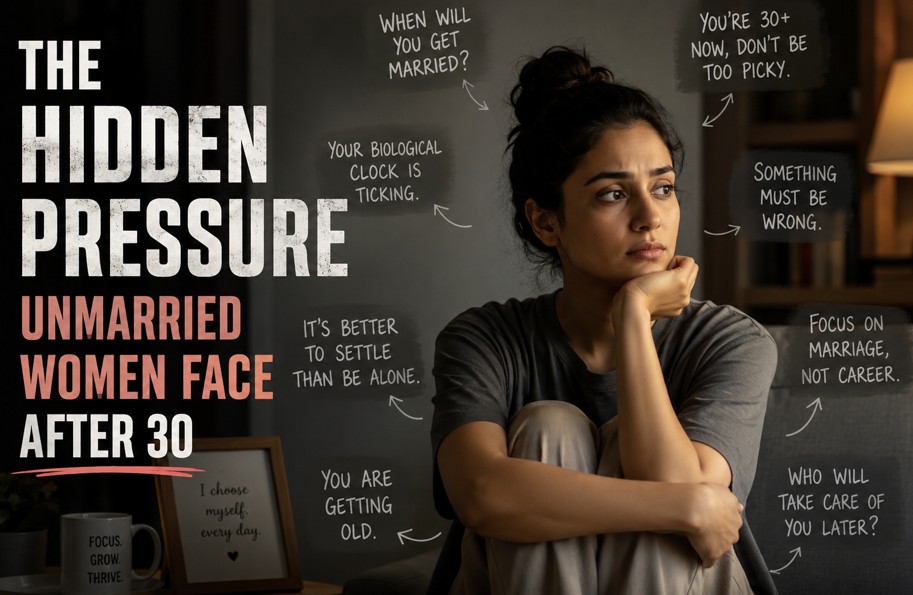

The Hidden Pressure Unmarried Women Face After 30

In many societies, turning 30 is often seen as a major life milestone. For women especially, this age carries expectations that go far beyond career achievements or personal growth. Questions about marriage, family planning, social status, and “settling down” begin to intensify. While modern women today are more educated, independent, and career-focused than ever before, the emotional and social pressure surrounding marriage after 30 has not disappeared. In many cases, it has simply become more hidden, subtle, and psychologically exhausting.
Behind the confident smiles, successful careers, and active social lives of many unmarried women over 30 lies a reality that few openly discuss. Society may celebrate independent women publicly, but privately many still face judgment, assumptions, unsolicited advice, and emotional stress simply because they are not married yet.
This pressure exists in different forms across cultures, families, and social classes. In cities like Dhaka, especially in elite areas such as Gulshan, Banani, Bashundhara, Uttara, and DOHS neighborhoods, women today are balancing higher education, demanding careers, personal goals, and family expectations all at once. Many genuinely want marriage, but not at the cost of compromising their dignity, safety, or future happiness. Others are still searching for emotional compatibility in a world where superficial standards often dominate matchmaking.
The reality is simple: being unmarried after 30 is not a failure. Yet society often treats it like one.
This article explores the hidden emotional, social, psychological, and practical pressures unmarried women face after 30, why these pressures continue to exist, and how modern marriage culture is slowly changing.
The Social Timeline Society Creates for Women
From a very young age, many girls grow up hearing a fixed timeline for life:
- Study well
- Graduate
- Get married
- Have children
- Build a family
This timeline becomes deeply embedded in social thinking. Even highly progressive families sometimes unconsciously follow it. When a woman reaches 30 unmarried, society begins treating her life as “delayed” or “incomplete.”
Men are often praised for focusing on careers in their 30s. Women, however, are frequently asked:
- “Why are you still single?”
- “Are you too picky?”
- “Don’t wait too long.”
- “Career is fine, but family matters more.”
- “Good proposals won’t come forever.”
Over time, these comments create invisible emotional pressure.
Even women who are emotionally strong and financially independent can feel affected by constant questioning. The pressure becomes exhausting not because of one comment, but because of repeated reminders that society sees marriage as a measurement of a woman’s success.
Family Pressure Often Comes From Fear, Not Cruelty
Many unmarried women after 30 experience increasing pressure from family members. Parents worry about:
- Social judgment
- Future security
- Biological age
- Loneliness
- Community gossip
- Finding “suitable” matches later
In South Asian culture especially, parents often feel personally responsible for their daughter’s marriage. As years pass, anxiety inside the family grows stronger.
This can lead to:
- Emotional blackmail
- Daily discussions about marriage
- Comparing daughters with married relatives
- Pressuring women to compromise quickly
- Accepting unsuitable proposals out of fear
Many parents mean well. Their concern usually comes from love and social conditioning rather than bad intentions. However, constant pressure can still damage a woman’s emotional wellbeing.
Some women begin avoiding family gatherings entirely because they know the same topic will dominate every conversation.
The Emotional Weight of Constant Comparison
One of the hardest parts of being unmarried after 30 is comparison.
Social media makes this even worse. Women constantly see:
- Wedding photos
- Pregnancy announcements
- Anniversary celebrations
- Family vacations
- “Perfect couple” content
Meanwhile, relatives and friends may unintentionally say things like:
- “Everyone is settled except you.”
- “You’re next.”
- “Don’t delay too much.”
- “Look at your younger cousin, she already has two kids.”
These comparisons slowly create emotional exhaustion.
Even confident women may privately question themselves:
- “Am I falling behind?”
- “Did I focus too much on career?”
- “Will I ever find the right person?”
- “Am I asking for too much?”
- “What if I end up alone?”
This internal conflict becomes emotionally draining because women are trying to balance self-respect with societal expectations.
Career Success Does Not Protect Women From Marriage Pressure
Many people assume educated and financially independent women feel less pressure about marriage. In reality, successful women often face a different kind of pressure.
Society sometimes views highly successful women as:
- “Too independent”
- “Too career-focused”
- “Hard to manage”
- “Intimidating”
- “Too selective”
Ironically, the qualities that make women successful professionally can sometimes reduce marriage opportunities in traditional mindsets.
Some men and families still prefer women who are:
- Less ambitious
- Financially dependent
- More socially adjustable
- Less opinionated
As a result, many accomplished women struggle to find emotionally mature partners who genuinely respect equality.
This creates frustration because women are often forced to choose between:
- Lowering standards
- Hiding achievements
- Compromising ambitions
- Remaining patient despite social pressure
Marriage Market Bias After 30
One uncomfortable reality is that age bias still exists strongly in matchmaking culture.
Many families openly prefer younger brides, even when men themselves are significantly older. Women over 30 often notice:
- Fewer proposals
- More judgment
- Questions about “why still unmarried”
- Pressure to accept divorced or incompatible matches quickly
- Unrealistic expectations from families
Some women begin feeling treated like products in a marketplace where age unfairly determines value.
This mindset is deeply harmful because maturity, emotional intelligence, life experience, and stability often improve with age.
Yet societal conditioning continues to prioritize youth over compatibility.
The Pressure to “Compromise”
Women over 30 are frequently advised to compromise more.
People may tell them:
- “Nobody is perfect.”
- “You should adjust.”
- “At this age, don’t expect too much.”
- “Good men are already taken.”
- “Just settle down.”
This advice can become dangerous when it encourages women to ignore serious red flags such as:
- Anger issues
- Disrespect
- Financial irresponsibility
- Controlling behavior
- Emotional immaturity
- Toxic family environments
Many women fear making the wrong decision more than remaining unmarried.
And honestly, this fear is understandable.
A delayed marriage is often healthier than a deeply unhappy one.

Loneliness Is Real — But Rarely Discussed Honestly
Not every unmarried woman after 30 feels lonely. Many enjoy independence, freedom, and self-growth.
However, loneliness can still exist quietly.
There are moments when women may wish for:
- Emotional companionship
- Someone to share daily life with
- Family support
- A stable partner
- Emotional security
The problem is society often misunderstands loneliness.
If a woman expresses emotional vulnerability, people may respond:
- “See? You should have married earlier.”
- “Now you understand.”
- “This is why family matters.”
As a result, many women suppress honest emotions to avoid judgment.
Being emotionally honest becomes difficult because society weaponizes vulnerability against unmarried women.
Friendships Begin Changing After 30
Another hidden challenge is changing social dynamics.
As friends marry and build families:
- Priorities change
- Time becomes limited
- Conversations shift
- Social circles evolve
Unmarried women may sometimes feel emotionally disconnected from married friend groups.
Events may become centered around:
- Children
- Parenting
- Couples
- Family activities
Some women begin feeling like outsiders in spaces they once belonged to comfortably.
This transition can create unexpected emotional isolation.
The Biological Clock Conversation
Perhaps one of the most emotionally sensitive pressures involves fertility and biological timelines.
Women hear constant warnings like:
- “Time is running out.”
- “Pregnancy becomes difficult later.”
- “Don’t wait too long.”
While biology is a real factor, society often discusses it in a fear-based and insensitive manner.
Women are reminded about fertility so frequently that it creates anxiety even when they are emotionally unready for marriage.
The issue becomes more stressful because:
- Women cannot force compatibility
- Healthy relationships take time
- Safe marriages matter more than rushed decisions
Fear-driven marriages rarely create long-term happiness.
Why Many Women Choose to Wait
Despite pressure, many women intentionally delay marriage today.
The reasons are often thoughtful and valid:
- Past heartbreak
- Career goals
- Financial independence
- Family responsibilities
- Fear of toxic marriages
- Desire for emotional compatibility
- Mental health priorities
- Previous trauma
- Observing unhappy marriages around them
Modern women increasingly understand that marriage affects every part of life:
- Emotional wellbeing
- Financial stability
- Personal freedom
- Future children
- Career growth
- Mental peace
As a result, many are choosing quality over urgency.
This is not selfishness.
It is self-awareness.
The Rise of Emotional Intelligence in Modern Matchmaking
One positive change is that modern marriage conversations are slowly evolving.
Today, many educated women prioritize:
- Respect
- Communication
- Emotional maturity
- Shared values
- Mental stability
- Trust
- Privacy
- Partnership mindset
External status alone is no longer enough.
A man may be financially successful, but women increasingly ask:
- Is he emotionally supportive?
- Does he respect women?
- Can he communicate maturely?
- Does he believe in partnership?
- Is his family healthy emotionally?
This shift is changing marriage culture slowly but significantly.
Society Celebrates Independence — But Still Judges Single Women
Modern society often sends mixed messages.
Women are encouraged to:
- Study hard
- Build careers
- Become independent
- Be ambitious
But when women actually become independent, society sometimes becomes uncomfortable.
An unmarried independent woman over 30 may face assumptions like:
- “She’s too proud.”
- “She doesn’t need anyone.”
- “Her standards are unrealistic.”
- “She focused too much on work.”
This contradiction creates emotional confusion.
Women are expected to succeed — but not become “too independent.”
Mental Health Impact of Marriage Pressure
Continuous pressure about marriage can affect mental health deeply.
Some women experience:
- Anxiety
- Low self-esteem
- Emotional burnout
- Depression
- Social withdrawal
- Overthinking
- Fear about the future
Unfortunately, mental health discussions around unmarried women are still limited in many cultures.
People often dismiss emotions with:
- “It will happen when the time comes.”
- “Don’t think too much.”
- “Everything happens for a reason.”
While well-intentioned, these responses sometimes ignore genuine emotional struggles.
Women need empathy, not constant advice.
The Problem With “Perfect Life” Expectations
Another major issue is unrealistic expectations created by society and social media.
Many women feel pressured to achieve everything perfectly:
- Successful career
- Beautiful appearance
- Perfect marriage
- Happy family
- Social success
This creates impossible emotional standards.
Real life is far more complicated.
Marriage itself does not automatically solve loneliness, insecurity, or unhappiness. Many married people silently struggle with:
- Emotional neglect
- Toxic relationships
- Financial stress
- Compatibility problems
- Family conflict
But society often hides these realities while glorifying marriage publicly.
As a result, unmarried women sometimes feel they are missing a fantasy rather than reality.
Why Respectful Matchmaking Matters Today
Modern matchmaking should reduce pressure, not increase it.
Professional and trusted marriage media services are becoming more important because they focus on:
- Compatibility
- Privacy
- Education
- Family values
- Lifestyle matching
- Serious intentions
Unlike random social media interactions, quality matchmaking platforms help families avoid:
- Fake profiles
- Time wasting
- Manipulative behavior
- Unsafe communication
Most importantly, respectful matchmaking treats women as human beings — not deadlines.
The Double Standards Women Face
Society still applies different standards to men and women regarding age and marriage.
A man unmarried at 35 may be described as:
- Successful
- Focused
- Established
A woman unmarried at 35 may unfairly face:
- Suspicion
- Pity
- Judgment
- Unwanted advice
This double standard reflects outdated gender expectations that modern society still struggles to fully abandon.
Fortunately, younger generations are beginning to challenge these beliefs more openly.
Building Self-Worth Beyond Marital Status
One of the most important lessons modern women are learning is this:
Marriage is part of life — not the entire definition of life.
A woman’s value does not decrease because she is unmarried at 30, 35, or beyond.
She can still be:
- Successful
- Kind
- Attractive
- Intelligent
- Emotionally complete
- Family-oriented
- Respected
- Happy
Healthy marriage should add peace to life, not become society’s tool for measuring worth.
How Families Can Support Unmarried Women Better
Families play a major role in reducing emotional pressure.
Supportive families can:
- Stop comparing daughters with others
- Respect emotional boundaries
- Avoid daily marriage discussions
- Focus on compatibility over urgency
- Listen without judgment
- Encourage emotional wellbeing
- Avoid panic-based decisions
Women feel emotionally safer when families become supportive partners instead of constant pressure sources.
The Future of Marriage Is Changing
Marriage culture is evolving globally and in Bangladesh as well.
Modern relationships increasingly prioritize:
- Emotional safety
- Mutual respect
- Shared goals
- Mental compatibility
- Partnership
- Communication
Women today are more aware of unhealthy relationship patterns than previous generations.
This awareness may delay marriage timelines slightly, but it also helps many avoid deeply damaging relationships.
In the long run, thoughtful marriages are healthier than rushed ones.
Final Thoughts
The hidden pressure unmarried women face after 30 is real, complex, and emotionally exhausting. It comes from society, family expectations, cultural conditioning, social comparison, and internal fears about the future.
Yet behind this pressure lies another truth:
many women today are becoming more emotionally intelligent, self-aware, and careful about choosing life partners.
Wanting a healthy relationship is not unrealistic.
Refusing toxic compromise is not selfish.
Taking time to choose wisely is not failure.
Marriage should never happen simply because society is impatient.
The right partnership is not built through fear, pressure, or desperation. It is built through trust, respect, emotional maturity, and genuine compatibility.
As society evolves, hopefully more people will understand that a woman’s worth is never defined by how quickly she marries.
Because a peaceful life matters more than a rushed timeline.
The Silent Strength Many Unmarried Women Develop After 30
One aspect society rarely talks about is the incredible emotional strength many unmarried women develop after the age of 30. While the outside world often focuses only on their marital status, it ignores the resilience, maturity, and independence they build through life experiences.
By this stage of life, many women have already faced:
- Career challenges
- Financial responsibilities
- Family expectations
- Emotional heartbreak
- Social judgment
- Personal disappointments
- Self-discovery journeys
These experiences shape women into emotionally stronger individuals. They learn how to manage stress independently, make important life decisions, support their families, and build stable lives without depending on others emotionally or financially.
Unfortunately, society often overlooks these achievements because marriage still dominates how women are evaluated socially.
In reality, many unmarried women after 30 become deeply self-aware. They understand:
- What kind of relationship they truly want
- What behavior they cannot tolerate
- What values matter most in long-term partnership
- How to identify emotional manipulation
- Why mental peace is more important than social appearance
This maturity can actually lead to healthier marriages later in life because decisions are made with wisdom rather than emotional impulsiveness.
The Fear of Public Judgment
Another hidden burden unmarried women carry is the fear of public judgment in social environments.
Family gatherings, weddings, community events, and even casual conversations can become emotionally uncomfortable. Many women mentally prepare themselves before attending social functions because they know questions about marriage may arise repeatedly.
Common experiences include:
- Relatives asking personal questions publicly
- People making jokes about age and marriage
- Unwanted matchmaking suggestions
- Gossip behind their backs
- Sympathy that feels insulting rather than supportive
Over time, some women begin avoiding events completely to protect their peace of mind.
This emotional exhaustion is rarely visible from the outside. People often assume unmarried women are “too busy” or “too independent” to care, but many are simply tired of constantly defending their life choices.
Why Society Needs More Compassion
Unmarried
The conversation around unmarried women after 30 needs more compassion and less judgment.
Not every unmarried woman is single by choice. Some simply have not found compatible partners yet. Others may have walked away from unhealthy relationships, toxic engagements, or emotionally unsafe situations. Some prioritize caring for parents or building financial security before marriage.
Every woman has a unique life journey.
Marriage is one important part of life, but it should never become a source of humiliation, pressure, or emotional suffering. A healthy society should support women regardless of their marital status.
Instead of asking:
- “Why aren’t you married yet?”
People should ask:
- “Are you happy?”
- “Are you emotionally well?”
- “Are you living the life you want?”
Because true success in life is not about following society’s timeline perfectly. It is about building a life filled with dignity, peace, emotional safety, and meaningful relationships.
As modern culture continues to evolve, more families are beginning to understand that delayed marriage is not the same as failed life. Women today are redefining what happiness, partnership, and fulfillment truly mean.
And perhaps that change is long overdue.