






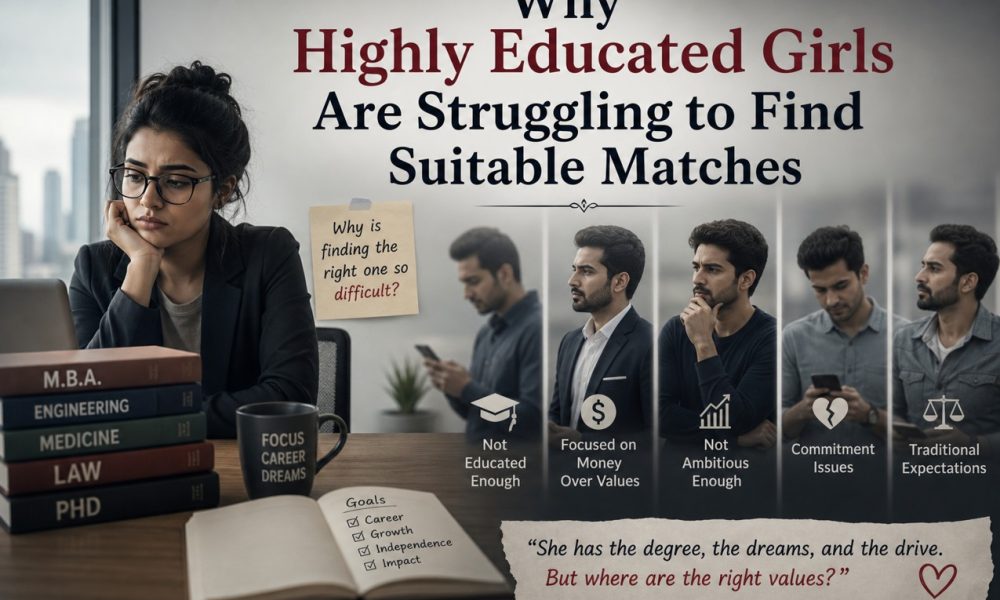

Why Highly Educated Girls Are Struggling to Find Suitable Matches
Introduction: A Growing Paradox in Modern Marriage
In today’s Bangladesh, one of the most surprising and often uncomfortable realities is this: the more educated a girl becomes, the harder it often is for her to find a suitable match.
At first glance, this seems completely illogical. Education is supposed to enhance a person’s value—socially, intellectually, and economically. A highly educated woman brings stability, awareness, communication skills, and often financial independence. So why is she struggling?
This is not just a personal issue—it is a deep social, cultural, and psychological phenomenon rooted in tradition, gender expectations, and changing societal dynamics.
Interestingly, while Bangladesh has historically struggled with early marriage, where education actually delayed marriage timing (ResearchGate), the opposite problem is now emerging in urban and educated communities: delayed marriage due to mismatch in expectations and social realities.
This blog explores the real reasons behind this growing issue, breaking myths and uncovering uncomfortable truths.
- The Shrinking Pool Problem
One of the biggest reasons highly educated girls struggle to find matches is simple mathematics: the pool of suitable men becomes smaller.
Educational Matching Expectations
Most families—and women themselves—prefer a partner who is:
- Equal or higher in education
- Stable or higher in income
- Socially compatible
This creates a filtering effect.
For example:
- A woman with a Master’s degree or foreign education will often not consider a less-educated partner.
- Meanwhile, many men do not prioritize a woman’s education the same way.
This creates a mismatch.
The result? A narrow intersection of acceptable candidates, making matches rare.
- Ego and Masculinity Crisis
This is one of the most sensitive but real issues.
Many men—even educated ones—feel uncomfortable marrying a woman who is:
- More educated
- More successful
- More financially independent
This is not always openly expressed, but it exists deeply within social conditioning.
A widely discussed concern in South Asian societies is that:
A highly educated woman may be seen as “too independent” or “difficult to control.”
Even global discussions highlight this issue. In some cases, families fear that a “too educated” woman might create ego conflicts in marriage, especially in traditional setups.
- Delayed Marriage Age
Education takes time.
- Bachelor’s degree → 22–23 years
- Master’s degree → 24–26 years
- Career establishment → 26–30 years
By the time many women feel ready for marriage, they are already in their late 20s or early 30s.
Why This Matters:
- In traditional marriage markets, younger brides are still preferred
- Families become anxious about “late marriage”
- Proposal frequency decreases with age
Research shows that education significantly delays marriage age, which is generally positive for empowerment (ResearchGate)—but socially, it creates new challenges.
- High Expectations (Both Realistic & Unrealistic)
Highly educated women tend to have:
- Clear life goals
- Emotional awareness
- Strong personal boundaries
This often translates into higher expectations from a partner:
- Intellectual compatibility
- Emotional maturity
- Respect for career
- Shared values
While these are reasonable expectations, they also reduce the number of acceptable matches.
From real-life experiences shared online:
“Men don’t prefer women with high academic qualifications… and families often label such girls as ‘too picky’.” (Reddit)
This creates a psychological pressure where:
- Women are told to “lower standards”
- Families push for compromise
- Good matches are rejected due to mismatch in expectations
- Career vs Marriage Conflict
Highly educated women often prioritize:
- Career growth
- Financial independence
- Personal development
But in many traditional families:
- Women are expected to adjust or sacrifice career after marriage
- Household responsibilities are prioritized over professional ambitions
Research confirms that:
Marriage often forces women to shift priorities, making it difficult to continue education or career after marriage (BMJ Open)
This creates a conflict:
- Women want supportive partners
- Families expect traditional roles
Result: Mismatch and rejection
- Social Stereotypes About Educated Women
Despite progress, stereotypes still exist:
Highly educated women are often labeled as:
- “Too career-focused”
- “Less family-oriented”
- “Too modern”
- “Hard to adjust”
These assumptions are not only unfair—they are damaging.
They lead to:
- Fewer proposals
- Biased judgment during matchmaking
- Unnecessary rejection
- Family Pressure and Anxiety
Ironically, educated girls face more pressure from family, not less.
Families often think:
- “We invested so much in education, now she must get a ‘perfect match’”
- “Time is running out”
- “Society will talk”
This pressure leads to:
- Rushed decisions
- Emotional stress
- Compromised compatibility
- Economic Independence Changes Dynamics
Education often leads to financial independence.
This changes marriage dynamics significantly:
Before:
- Women depended on husbands
- Marriage was a necessity
Now:
- Women can live independently
- Marriage becomes a choice
This creates a shift:
- Women become more selective
- They reject unsuitable proposals
While this is empowering, it also reduces match frequency.
- Cultural Transition: Old vs New Values
Bangladesh is currently in a transitional phase:
| Traditional Mindset | Modern Mindset |
| Early marriage | Late marriage |
| Family decides | Individual choice |
| Women dependent | Women independent |
This clash creates confusion:
- Families follow old values
- Women follow new values
And the result is conflict in matchmaking.
- The Double Standard Problem
Men:
- Can marry later
- Can marry less-educated women
- Face less pressure
Women:
- Face age pressure
- Expected to “adjust”
- Judged more harshly
This double standard creates an imbalance.
- The “Overqualification” Myth
Some families believe:
“Too much education makes a girl unsuitable for marriage.”
This mindset still exists in parts of society.
Even discussions around dowry and social expectations show that:
- Families sometimes fear highly educated daughters may face difficulties in marriage due to ego conflicts or expectations
This creates a paradox:
- Education is encouraged
- But “too much education” is discouraged
- Urban vs Rural Divide
In rural areas:
- Early marriage is still common
- Education is often secondary
In urban areas:
- Education is prioritized
- Marriage is delayed
Bangladesh still has one of the highest early marriage rates globally, with a large percentage of women marrying before 18 (Nature)
This contrast creates:
- Two different marriage cultures
- Difficulty in finding compatible partners across these divides
- Emotional Intelligence Gap
Highly educated women often develop:
- Better communication skills
- Emotional awareness
- Critical thinking
But many men:
- Are not taught emotional intelligence
- Lack relationship skills
This creates compatibility issues:
- Miscommunication
- Frustration
- Rejection
- Fear of Divorce and Independence
Some families fear:
- Educated women are more likely to question authority
- Less likely to tolerate unfair treatment
This creates hesitation among conservative families.
- Social Image and Status Pressure
Marriage in Bangladesh is still heavily linked to:
- Family reputation
- Social status
- Community perception
For educated girls:
- Expectations are extremely high
- “Perfect match” pressure increases
Real-Life Insight (From Community Discussions)
From online discussions:
“Ambitious, educated women scare insecure men.” (Reddit)
While this may sound harsh, it reflects a real social perception.
So, Who Is Actually Responsible?
The truth is:
👉 Not just men
👉 Not just women
👉 Not just families
It is a systemic issue involving:
- Cultural norms
- Gender roles
- Economic realities
- Psychological conditioning
Solutions: What Can Be Done?
- Change Mindset About Education
Education should be seen as:
- A strength
- Not a threat
- Encourage Equal Partnerships
Marriage should be:
- Based on compatibility
- Not hierarchy
- Normalize Late Marriage
Late marriage is not failure—it is often maturity and preparedness.
- Promote Emotional Intelligence
Men need:
- Communication skills
- Emotional maturity
- Reduce Family Pressure
Marriage is a life decision—not a social deadline.
- Use Professional Marriage Media
Modern matchmaking services can:
- Filter compatible matches
- Maintain privacy
- Reduce unnecessary pressure
Conclusion: A New Reality of Marriage
The struggle of highly educated girls in finding suitable matches is not a problem—it is a signal of societal transformation.
It shows that:
- Women are evolving
- Expectations are changing
- Traditional systems are being challenged
Yes, the journey is difficult.
Yes, the process is slower.
But it is also leading toward:
👉 More meaningful marriages
👉 Better compatibility
👉 Stronger partnerships
Why Highly Educated Girls Are Struggling to Find Suitable Matches (Extended Analysis)
- The “Compatibility Gap” Is Wider Than Ever
One of the least discussed but most important reasons behind this issue is the growing compatibility gap.
Highly educated women today are not just academically qualified—they are:
- Globally aware
- Digitally connected
- Exposed to diverse cultures and ideas
- Mentally and emotionally evolved
However, not all men in the same marriage pool have experienced similar exposure.
This creates a mismatch in:
- Conversations
- Lifestyle expectations
- Worldviews
- Decision-making styles
For example, a woman who has studied abroad or worked in a multinational company may expect:
- Equal partnership
- Open communication
- Shared responsibilities
But if the man comes from a more traditional mindset, even if he is educated, the gap becomes obvious.
This is not about “better” or “worse”—it is about alignment, which is becoming harder to find.
- The Rise of Self-Respect and Boundaries
Modern educated women are increasingly aware of:
- Their self-worth
- Their emotional needs
- Their personal boundaries
Unlike previous generations, they are less likely to:
- Accept disrespect
- Tolerate toxic behavior
- Compromise on core values
This is a major positive shift—but it also leads to:
- More rejections
- Longer search periods
- Fewer compromises
Earlier, many marriages worked because women were expected to “adjust.”
Now, the expectation is shifting toward mutual adjustment, which is still not widely accepted.
- The “Too Independent” Label
Independence should be a strength, but in many cases, it is perceived as a threat.
Highly educated women who:
- Live alone
- Earn well
- Make their own decisions
Are often labeled as:
- “Too independent”
- “Hard to manage”
- “Not family-oriented”
This perception discourages many potential matches, even before meaningful conversations begin.
The irony is:
👉 The same independence that makes a woman strong also makes her seem “less desirable” in traditional marriage settings.
- The Role of Social Comparison
Social media has added a new dimension to marriage decisions.
Families and individuals constantly compare:
- Education levels
- Salaries
- Lifestyle
- Social status
Highly educated women are often compared to:
- “Even better” proposals
- “Higher status” families
This leads to:
- Endless waiting for a “perfect match”
- Rejection of good but “not ideal” proposals
This phenomenon is often called “comparison paralysis.”
- The Illusion of Endless Choices
With the rise of online matchmaking platforms, people believe:
“There are thousands of options—why settle for less?”
This affects highly educated women in two ways:
- Increased Expectations
They believe they should find:
- Perfect compatibility
- Ideal personality
- Equal or better status
- Decision Fatigue
Too many options lead to:
- Confusion
- Indecision
- Constant dissatisfaction
As a result, even good matches are overlooked.
- Marriage Is No Longer a Necessity
In the past:
- Marriage was essential for survival
- Women depended on husbands financially and socially
Now:
- Women can live independently
- Build careers
- Travel
- Make life decisions on their own
This changes the entire purpose of marriage.
For highly educated women:
👉 Marriage becomes a choice, not a necessity
And when something is a choice, the standards automatically become higher.
- Fear of Losing Freedom
Many educated women hesitate to marry because they fear:
- Losing independence
- Being restricted by in-laws
- Career limitations
- Social expectations
Even if a proposal looks good on paper, these concerns create hesitation.
This leads to:
- Delayed decisions
- Rejections
- Emotional conflict
- The “Adjustment Burden” Problem
In many cultures, including Bangladesh, the expectation still exists that:
The woman must adjust more after marriage.
Highly educated women question this imbalance:
- Why should only one person adjust?
- Why is compromise not equal?
When they do not accept this unequal expectation, conflicts arise during matchmaking.
- Lack of Suitable Communication During Matchmaking
Another overlooked issue is the quality of communication during the proposal stage.
Often:
- Conversations are formal and limited
- Real personality is hidden
- Important topics are avoided
Highly educated women, however, want:
- Deep conversations
- Honest discussions
- Clarity about future plans
When these are missing, they lose interest.
- The “Checklist Culture”
Modern matchmaking has become highly transactional.
Families and individuals create checklists:
- Education
- Salary
- Height
- Family background
- Location
Highly educated women are often judged strictly by these checklists, ignoring:
- Personality
- Values
- Emotional compatibility
This reduces the chances of meaningful connections.
- The Pressure to Be “Perfect”
Highly educated women face a unique pressure:
They are expected to be:
- Career-oriented
- Family-oriented
- Well-mannered
- Attractive
- Socially skilled
In short, they are expected to be perfect in every way.
This unrealistic expectation:
- Increases stress
- Reduces confidence
- Makes matchmaking more difficult
- The Changing Role of Men
While women have evolved rapidly, many men are still in transition.
Some men struggle with:
- Accepting equality
- Sharing responsibilities
- Supporting a partner’s career
This creates a gap between:
- What women expect
- What men are ready to offer
- The Impact of Past Experiences
Highly educated women often have:
- Past relationship experiences
- Emotional learning
- Better understanding of compatibility
This makes them:
- More cautious
- Less impulsive
- More selective
While this is healthy, it also slows down the process of finding a match.
- The Role of Urban Lifestyle
Urban life has changed priorities:
- Career comes first
- Social life is diverse
- Exposure is global
Marriage is no longer the central focus of life.
For many educated women:
👉 Marriage becomes one part of life—not the whole life
This reduces urgency.
- The Fear of Settling for Less
One of the strongest reasons is psychological:
“After achieving so much in life, why should I settle?”
Highly educated women often feel:
- They have worked hard for their position
- They deserve a partner who matches their level
This is not arrogance—it is a reflection of self-respect and effort.
- The Influence of Peer Circles
Friends and colleagues play a big role.
If a woman’s peer group:
- Marries late
- Prioritizes career
- Values independence
She is more likely to follow the same path.
This creates a cultural shift within educated circles.
- The “Timing Mismatch” Problem
Sometimes the issue is not compatibility—it is timing.
- When a woman is ready, the right person is not available
- When a good proposal comes, she may not feel ready
This mismatch delays marriage further.
- The Emotional Cost of Waiting
While being selective is important, it also comes with emotional challenges:
- Loneliness
- Anxiety
- Social pressure
- Self-doubt
Highly educated women often face silent struggles:
- “Am I too picky?”
- “Is something wrong with me?”
These thoughts can be mentally exhausting.
- The Role of Marriage Media and Matchmaking Services
Modern marriage media platforms are trying to bridge this gap by:
- Providing filtered matches
- Ensuring privacy
- Understanding preferences
However, even these platforms face challenges:
- Unrealistic expectations
- Lack of flexibility
- Communication gaps
- The Need for a Mindset Shift
The core issue is not education—it is mindset.
Society needs to shift from:
❌ Control → Partnership
❌ Superiority → Equality
❌ Adjustment → Mutual respect
Until this shift happens, the struggle will continue.
- What Highly Educated Women Can Do
This is not about “blaming” women, but about strategy:
- Focus on Compatibility, Not Perfection
No one is perfect—look for alignment, not flawlessness.
- Communicate Clearly
Express expectations early to avoid confusion.
- Stay Open-Minded
Sometimes good matches come in unexpected forms.
- Balance Standards with Flexibility
Standards are important—but rigidity can be limiting.
- What Men Need to Understand
Men must realize:
- Education is not competition
- Independence is not rebellion
- Equality is not a threat
A strong partner:
👉 Strengthens the relationship, not weakens it
- What Families Should Change
Families need to:
- Reduce pressure
- Avoid unrealistic expectations
- Focus on compatibility over status
Marriage is not a social show—it is a lifelong partnership.
- The Future of Marriage in Bangladesh
The future will likely see:
- More late marriages
- More educated couples
- More equal partnerships
The current struggle is part of a transition phase.
- Final Extended Reflection
The difficulty highly educated girls face in finding suitable matches is not a failure—it is a reflection of growth.
It shows that:
- Women are becoming more aware
- Standards are evolving
- Society is slowly changing
Yes, the process is longer.
Yes, it is more challenging.
But it is also leading to:
- Healthier relationships
- Better understanding
- Stronger foundations
Ultimate Closing Thought
The real issue is not:
👉 “Too much education”
The real issue is:
👉 “Not enough evolution in mindset”
When society catches up with the growth of women,
this problem will naturally disappear.